by Maura Thomas
Members of local entrepreneur organization Bootstrap Austin have made a strong showing in panel submissions for next spring's South by Southwest Interactive Conference.
Support these local entrepreneurs by clicking on the links to vote for their panels. Public support is 30% of the weight given when panels are chosen, and this year's competition is fierce, with over 3,000 panels submitted, and only room for 300 sessions. Panel voting ends September 4th.
Following are the panels that have been submitted by Bootstrap Austin members, alphabetically by Bootstrapper/presenter last name.
Karen Bantuveris, VolunteerSpot: Doing Good Online: Mobilizing Community Action - http://panelpicker.sxsw.com/ideas/view/4906
Greg Bright : Get Top Ranking on Google and Other Search Engines - http://panelpicker.sxsw.com/ideas/view/2657
Michael Drapkin, Anime Winds: Symphonic Rockstars: Mainstreaming Traditional Virtuosity - http://panelpicker.sxsw.com/ideas/view/2689
Michael Drapkin, PrismNet, Ltd.: Thinking Like An Owner - Starting Your Interactive Enterprise - http://panelpicker.sxsw.com/ideas/view/2658
Lou Ellman, RoyaltyZone: The Tangled Web of Artist Royalties - http://panelpicker.sxsw.com/ideas/view/4257
Aruni Gunasegaram, entrepreMusings: Online/Offline Networking in the Social Media Age - http://panelpicker.sxsw.com/ideas/view/2851
Danny Gutknecht, The Heuristic Soul - How Can Authentic Communication be Social and A Pragmatic Approach to Wild Creativity: http://budurl.com/zqa7
Brian Massey, Conversion Sciences: What Is Your Social Conversion Rate? - http://panelpicker.sxsw.com/ideas/view/3531
Brian Massey, Conversion Sciences: Bigger Online Projects Through Personas - http://panelpicker.sxsw.com/ideas/view/3569
Matthew McCabe, Austin Social Innovation Hub: Social Apps To Save The World - http://panelpicker.sxsw.com/ideas/view/4667
Maura Nevel Thomas, RegainYourTime.com: Win the War Against Information Overload - http://budurl.com/9v4l
Pat Scherer, The Detail Person: Slacker Website Triage: Addressing Purpose, Usability and Conversion (with Brian Massey & Theresa Neil) - http://budurl.com/sxswslacker
Jan Triplett, Business Success Center: Successful Networking for Introverts, Rebels and Misfits (with Julie Gomoli) - http://bit.ly/4AK8L
Maura Thomas is an early member of Bootstrap Austin and founder of two Austin bootstrapped companies: RegainYourTime.com and Avail Assistants. In Maura's 15 years in the productivity training industry, she developed a process for peak effectiveness called the Empowered Productivity System. She has been invited to speak and train all over Texas and nationally. Maura is very active in the local small business community, and sits on several non-profit boards and committees, including being selected by The Climate Project and personally trained by former Vice President Al Gore to deliver his message on climate change.
Wednesday, August 26, 2009


Sunday, August 23, 2009
Interview with Bijoy Goswami
Last March, Bijoy Goswami and I sat down for a fascinating (and lengthy) conversation about mental models and bootstrapping at Progress Coffee on Austin's East Side (now Brew & Brew). The interview was recorded and transcribed. While preparing it for publication, Bijoy and I both felt it was important to stress that the chief mental model being explained here, that of the Maven-Relater-Evangelist, may or may not be useful to you in understanding your own place in the world. The point is not to take Bijoy's model, or anyone else's, and indiscriminately apply it to your own life. The point is rather to start thinking about how you might create models to better understand your own path.
- Sarah Vela
Bijoy, thanks so much for coming to speak with me today.
Absolutely, thank you.
I have a lot of questions for you. I would love to start off just by talking about mental models and what that means. What are mental models?
Mental models are something we do as humans so much, that we don't really realize we do it. The problem is that mental models inform everything we do. If you think about any activity that you might do as a human being, there's a mental model underneath it. Many folks have pointed the importance of mental models: Jean Piaget in education and Peter Senge in business, Darius Mahdjoubi here in town, to name a few. Wikipedia has a nice entry. Whether it's being a parent, or starting a business, or having a relationship, there's a mental model that you have about that issue, or that person, activity or or that entity.
I look at the process by which we come up with mental models: how do we articulate those mental models to each other and communicate them, and then where it goes wrong. For example, prejudice is basically a grooved-in mental model that has an incorrect view of reality. As humans we're constantly trying to make a model of reality through our brain that mediates everything that we do. To me, having better models is what we're about, to some extent. But because it's so natural and so ingrained, we don't think about the fact that that's what we're doing. My deal is to get people to build really good mental models for themselves, and to help them expose their own thought processes to themselves.
Give me an example of a mental model that you've created for yourself, and how did it help you?
The easiest one to start with is Maven, Relater, Evangelist, which I describe in my book The Human Fabric. MRE. Meals ready to eat (laughs). That model, number one, says that we're all different. So it takes the Golden Rule and turns it on its head. Yes, we're all human, but people have different energies and different locations on this triangle of energy: Maven, Relater, Evangelist. And where you're situated on that triangle influences your personality, the way you communicate, the way you relate, and so on and so forth. It's interesting because whenever I present the model to people they say, "But aren't I all three? I want to be all three!" People have a desire or built-in model that they should be all three, they should be good at all things, whatever those things are. The model is saying people have these different energies. We all do these activities. Just because the maven is living in thought space doesn't mean they take no actions. But it's the way that they take action that is important.
So, a model for people could be, "We're all the same," which is the Golden Rule. The Golden Rule pops out of a model that says people are all the same. And then you've got personality models all along the spectrum. If you march up the hill from one: "We're all the same," the most common mental model we use for "We're different" is men and women. We break up into two categories. Men are this way, women are that way. Clearly that's a fairly useful model, but it starts running out of steam pretty quickly, especially if you're trying to talk about our talents, our passions, and what we're doing. MRE is number three, it has three elements to it. Models like DISC have four. Enneagram has nine. And 16, Myers-Briggs, which is kind of the Microsoft, or the Google, of those (as in the 800 pound gorilla).
Again, the starting point is "Wait a second, people are not the same?" And "Oh yeah, I guess I see the world a certain way and I don't think about it." So number one is I've got to know myself. Because knowing yourself means you discover what you're good at and, perhaps more importantly, you discover what you're not good at.
So did creating that model help you to know where you fell in the model? Or did you already know.
I didn't know. And I didn't know the implications of it. Working on the model has helped me work out a number of things within and without myself. So, one of the big implications externally is that you seek out partners. Whatever activity you're doing, you seek out what I call a dance partner. I had been inadvertently finding dance partners in my life, but I hadn't realized the natural implication of this fact. I had inadvertently been developing what I call my Evangelist-Maven. So on this triangle I'm an Evangelist-Maven, I'm dominated by Evangelist energy, but my minor is Maven. And until then I didn't have a vocabulary for it. But it's interesting, back in high school I won the leadership and the academic awards...
Uh huh. So there you go.
There you go. It was already there, but no one said "Wow, you're a great evangelist, go work on that." I would take all these leadership roles, I would give lots of talks, do theater, those are all evangelist type of activities. Yet I was very studious. When I compared the two energies, really my Evangelist is my strong one. But not having the awareness that that was going on, or a model, I was just good at a lot of things.
It meant that I essentially spent a lot of time exploring avenues that weren't necessarily useful to explore. And if I knew that, I'd probably be more efficient about the way that I go went about it. So once I had a model for it, I could place myself in the model and realize I'm not supposed to do everything.
You were talking about dance partners earlier. I’m assuming those people were often relaters.
Or mavens. Yes, exactly. They were the complementary energy. Evangelists tended to be more of my friends, but we weren’t getting anything done because we were stepping all over each other. Whereas a maven or a relater, and more often mavens, because their strength was my minor, I could relate to them. But it wasn’t my deal, my core thing. One of my favorite examples is from high school. Our teacher, Miltinnie Yih, who was having us do Shakespeare creative projects. It was the morning it was due, and we’re waiting in front of the class for it to start, and I go, “I know, I’ll do a one-man King Lear.” So I’m writing it, I start Act I, I’m busily working on this thing, and my tall friend Jon Barden walks up to me, he says “hey, Bijoy.” And I’m like “yeah Jon,” kind of, can’t you see I’m busy?
Doing your one-man King Lear…
He goes, “what are you doing for your creative project?” I go, “I’m doing a one-man King Lear.” He goes, “wanna make it a two-man?” And I looked up and went, “Oh my god! Totally!” And we blew this thing out, it was the most hilarious project that I’d done, we ended up doing it at the theater in the school. The funny part was it was years later, and I did a short play called Mystic Cab, and then I turned it into a short film. Same thing. I decided to do a one-man, one act play. This was like five years ago. And I had been working on this thing and it was a total mess. I’m driving downtown and my friend Kert calls me and he says, “what are you doing?” I said, “I’m working on this thing, I signed up for FronteraFest at Hyde Park Theatre. I’m so screwed because five days from now I’m gonna have to present something, do 25 minutes of a play, and I’ve got nothing.” And he says, “I’ll do it with you.” And I said “oh my god, that would be so great.” And then I thought, why didn’t I think to ask him? Because he had some free time, he’s a theater guy. Right?
So now, have you learned? I mean now do you reach out?
Now, after 17 bonks on the head from the universe? (laughter). Yeah, I look at all my projects as collaborations now. And I think “who’s my dance partner, or dance partners?” within anything that I’m doing. The book I wrote was written with Dave Wolpert. The film I made was with Nils Juul-hansen. Bootstrap was one big collaboration. And I constantly go okay, my job is to reduce down into my thing and to create the space for others.
Now, one interesting caveat: I have a strong minor energy. Some people are very much on the points of the triangle. They’re like hard core mavens, hard core relater, hard core evangelist. Some of us are major-minors. We have a strong minor. Then we’ve got to reconcile within ourselves how those two integrate and don’t kill each other. I’ve had another journey, which is I was essentially outsourcing my maven to other people, and my internal maven was kind of pissed. Like, “hello dude, I’m here, I’m a maven.” And when the evangelist essentially took people off a cliff with my tech start-up, the maven said, “look, go in the corner, I’m gonna show you what’s up.” And in a sense these last number of years have been a maven exercise. My maven energy has been dominant in terms of building these models. And he showed my evangelist energy, “guess what, that’s my contribution. Yeah there’s these great mavens and relaters, and maybe even other evangelists that we want to partner with, but what you need to evangelize are these models. These are the creations that I’m coming up with, so now let’s work together.” So that’s another interesting self-reconciliation.
I find the choice of maven interesting, because I guess in my head there’s a little bit of a disconnect. I think of a maven as a proselytizer. But you think of a maven as a learner? or as a thinker?
An expert, yes.
An expert. Alright.
I mean these are just words, so you end up having to pick some word.
I’m just trying to understand the model a little bit better. And I think I do, but we have jumped so into it that I want to clarify it at this point. An evangelist is definitely your proselytizer, that’s definitely the person who is the leader, brings people together…
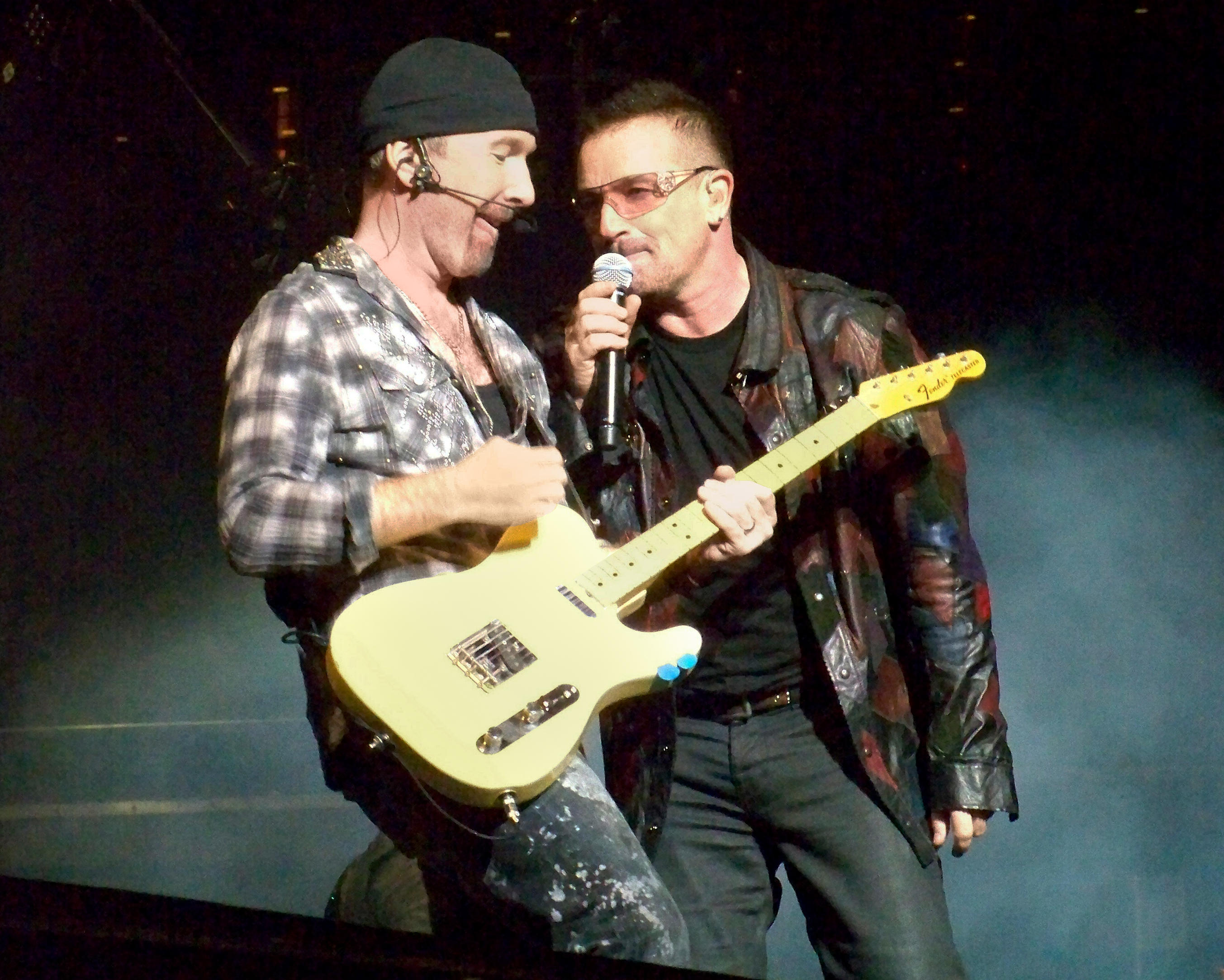
"Bono, not the Edge"
Bono, not The Edge. You know, The Edge is the maven, Bono is the evangelist. Steve Jobs, Steve Wozniak. You see these pairs.
And the relater? Where does the relater fit in? The relater feels like a third wheel to me, in your model. And that’s because you’re probably describing yourself that way.
That’s where I’m sitting, yeah. I live in that region of the world. The relater is the glue. The relater is, if we have The Human Fabric as the title of the book, the relater is the weaver of the human fabric. What they do is, mavens pick an area of the world and they study it. Relaters pick people. For relaters, people are the thing. And people are this infinite puzzle, and they’re just so interested in people. Oh my gosh, your journey, and how’s your day, and all this stuff. What they’re gathering data on is this entity called a person. And where they are. And then you should really talk to this person. My youngest brother is a total relater. and I have these great relaters in my world, and I look at what they do, and it’s incredible. It’s sometimes really frustrating, because as a maven or an evangelist you don’t think of a person as a universe unto themselves. but a relater does. So they’ll sit there and if you say, tell me about Joe, they’ll go oh, you know, and 20 minutes later you’ve got a soliloquy on Joe. And I’m like no, don’t tell me that much. What they’re doing, and this is the interesting thing, is I always used to draw the triangle as maven, evangelist, relater, like that…
Maven at the top.
Maven at the top. I didn’t know why. But I learned later that a model is already communicating information when you place the elements. So my friend Tina, who did the book cover, she has a company called Spoon Bend, it’s a graphic design marketing company. She took the triangle and she tipped it; and she also did three paintings that illustrated the energies of these three. She tipped it forward, and all of a sudden it all made sense. Because the evangelist was on the ground, pulling the triangle. the maven was stepping up on the top, and the relater was in the back, connecting, making sure everything is good, but taking a quiet role. That’s the thing with relaters is you can tell who the mavens are, you can tell who the evangelists are, the relaters are in the background - they’re the unseen third. But really each of these two resolves the duality for the other. So when the maven and the relater have a conflict, the evangelist can come in there and broker that discussion, because all of their energies are in a tight triangle like that. So, relaters are incredibly important.
Societies also fall into the triangle. Think of America: evangelist-maven. Right? I mean our dominant is we’re evangelists out here, we’re the Wild West, those are our heroes. Relaters don’t get much play here. Whereas in Japan, that’s a relater-maven culture. What’s Japan all about? It’s how you treat each other, how you interact. Whenever you’re looking for a culture’s energy, look at what they formalize. Germany: mavens. Uber-mavens.
You mentioned Hong Kong. Did you grow up in Hong Kong?
Yeah.
So how would you describe Hong Kong?

Hong Kong at night
Oh, evangelist. Very clearly. Which is interesting. Hong Kong and Singapore have an interesting relationship, because Singapore to me is maven, Hong Kong is very evangelist, and I always thought the obvious thing for them was to hook up and start, you know, getting all the business people in Hong Kong talking to the inventors and technologists in Singapore. That would be my economic prescription.
Tell me a little bit about Bootstrap Austin and your involvement with it.
I inadvertently stumbled into another model, which is bootstrapping. I would say bootstrap is the third way of entrepreneurship. So when we think about entrepreneurship, we think of it as one activity, and it’s not. It’s an infinite set of activities. I like to break things out into three. I think of the cookie cutter entrepreneurs, the funding-driven entrepreneurs, and the bootstrap entrepreneurs. Cookie cutters are anything from franchises to any business whose business model is already known. Doctors, lawyers…
Widget sellers…
Widget sellers. Someone else has already discovered the business model, and now you’re making one of your own, but you’re not making anything new. The new seems to always come from Silicon Valley, where you throw money at it, and you IPO it, and all that. But it turns out that bootstrapping is really the way that built-to-last companies get built. Microsoft, HP, Oracle, even Google…
So what is bootstrapping? What does that mean?
It means a lot of things. The simplest way I think of it as, from a business model point of view, is that the business model emerges from the process of bootstrapping.
And the process of bootstrapping is…
Is right action, right time. It’s demo, sell, build. It’s constraint creates innovation. It’s use everything. It’s most described by a story about Baron Munchausen. He supposedly found himself in a swamp. He’s drowning in the swamp, yelling for help, trying to get out of the swamp, no one’s there to help him. So he said well, I’m either going to be dead, or I’m able to get out. What am I going to do? I can’t get any help.

He looks around and sees his bootstraps, and pulls himself up by his bootstraps, and gets out of the swamp. There’s a competing myth which is that he pulled himself out by his hair, but "hairstrap" doesn’t quite roll off the tongue. So bootstrapping is that story. Wherever you are you can make progress. You can create something out of nothing. And what happens with people, is we often fall into “well, I don’t have what I need, I need to do this big thing so I need to go get resources from an external source.” That’s why Ir think of it as right action, right time. You are essentially letting something unfold and evolve and emerge, and you’re the shepherd of that emergence, you’re not the author and the controlling entrepreneur.
So it lends itself more to collaboration.
It does. It is fundamentally a co-creative process. You’re co-creating your ventures with your partners, with your customers, with the world. You’re on this journey of diminishing yourself into the right spot, and you’re watching what’s happening, and as you get better at watching, you make progress.
So we have this model, this map that we built, and it talks about the different elements that keep showing up. Each stage is nothing more than the birth of an element. So the “You” stage, the first stage, is the birth of you. What are your unique talents, what are your unique passions, what are you good at.
Once you start figuring that out, then you get into the “You plus You” (now called Quest(ion)) stage, where it’s like “Oh my gosh, do I want to go on this hero’s journey?” This is Joseph Campbell and all of that. Because many people are called, few take the action. That means that you’re going to go on this journey away from what society tells you that you’re supposed to do.
And if you say yes to that, then you enter into the “Ideation” phase. What are you going to do? That’s the birth of your “it.” Your product, your service, your experience, your cause, your community, whatever it is that you’re going to make. And then once you do that, you enter the Valley of Death. And then you’re on the hunt for this customer. You’re like, oh my gosh, someone please pay me for what I’m doing so I can be sustainable.

But all these elements keep going. The You still keeps going, the Inner Journey keeps going, the Product Journey keeps going, and the job of us as the entrepreneur is to weave them and integrate them together, so with the addition of a new element, kind of like a fugue, the addition of a new element doesn’t disrupt, but it forces and harmonizes with the previous elements.
I see this mental map as an animation. I mean, I imagine that it would be really useful to people. If mental mapping is about visualizing the process, or an idea, this is a particularly fluid process, as you describe it, as a fugue, as music. I wonder if you’ve ever thought about animating your mental maps.
I haven’t, but I’ve done some half-assed attempts in Power Point to show the elements coming in. But again I need my power of two on that.
Well I’m not the one to help you I’m afraid!
Thank you for illuminating a gap in my power of two (laughs). And not helping me at all.
You’re so welcome! As a relater maybe I can find somebody for you.
There you go.
Getting back to mental maps, or mental models. You say mental model, and a lot of other people say mind mapping, and I wonder if there’s a difference in your view about those two things.
Well, yeah. Mind Mapping is a very technical term where you essentially brainstorm by putting an idea in the center, and sort of spiking out. I remember when I discovered mind mapping in college. I was doing a research project in India, and I discovered mind mapping, and all of a sudden my world opened up, because it’s more mapped into the network structure of the brain. But a model is just a representation of reality. So a mind map could be a representation underneath that, but mind maps are subsets of all models.
Mind maps don’t work for me, and I think that has to do with how I learn. But I wonder if you run into this also with mental models. Are there people who absorb that information better and worse? Are there people who find this more or less useful? What is the response to mental models?
I think there’s a whole variety of responses. My models occupy the simple but not simplistic spot. My models are bootstrapping you into your mental models, if you like, to be sort of self-referential. Because I don’t want to give you the whole answer. What I find is mavens are the most dubious about my models, because I reduce them down.
I remember this art project that I did in 8th grade. I had a block to carve. And I started carving, and I had this elephant. My elephant was just this blocky thing, because I was afraid to cut too much, because you couldn’t glue it back on. That’s where I feel people are with mental models. And I’m always, like, cut, cut, cut down to the bone, so I can get to the essence. So when I say people fall into one of three categories, maven, relater, evangelist, both the mavens and the relaters go “noooo, that can’t be right.” Evangelists are like, “sweet, that’s easy, that’s quick, I need a quick model I can use,” so they’re good. Mavens are like, “that can’t be right. Really?” Because they look at people as mysterious.
And relaters like me say “but I’m all those things”
Exactly.
Because they relate.
Exactly. And “oh, people are so varied.” That’s where I get the resistance. Bootstrap, you get resistance from the other two sides. The cookie cutters go, “well, I want control over this, I’m not going to let it just go out.” And, “I need a business plan,” and stuff like that. And the funding-driven guys go, you know, “what are you talking about? I’m the master of the universe. I know what’s gonna happen, so why am i gonna let the process deliver?”
But you’re not creating the model for them.
Right.
So that’s okay.
It is, you’re right. That’s the subtlety of why I go slow with all this stuff, because I don’t want people to take my models and make them their reality. I want them to say, this is just showing up here. You asked about Bootstrap Austin. It started because I was even more convinced after my tech start-up deal, where I had raised half a million dollars from friends and family, spent it all, and found myself with nothing to show for it, going why didn’t I trust myself? I’m a bootstrapper, I knew about bootstrapping. I didn’t know the whole model. But I started with it back at Stanford.
I knew that was my path, not the Silicon Valley dominant path. What’s the founding company of Stanford? HP. Bootstrap. Scott Cook came and spoke, the founder of Quicken. Bootstrap. Oracle: bootstrap. And yet I had allowed myself to go away from my own intuition. So I was talking to a lot of entrepreneurs, and they wanted to get funding. This was 2002, 2003. And I said “dude, you want to bootstrap your company. You want control,” and so on and so forth. I was having all these lunches, coffees, and dinners, and it started to get to be a real pain. So I thought, I’ll get these people together, I’ll introduce them to each other, and that’s how Bootstrap Austin was born.
Bijoy, thanks for your time today, and good luck with SXSW and your upcoming projects!
Bijoy's Amazon list of suggested reading material can be found here.
Paintings by Tina Schweiger.
- Sarah Vela
About Bijoy:
Bijoy Goswami was born in Bangalore, India on April 15, 1973, to a Catholic mother and a Hindu father. They moved to Taiwan when he was ten, and Hong Kong when he was fourteen. He came to the U.S. in 1991 to attend Stanford, where he studied Computer Science, Economics, History and inter-disciplinary honors in Science, Technology and Society (STS). He moved to Austin in 1995 to join a software startup. In April, 2000 he co-founded a software company with his friend Bruce Krysiak. In 2003 he began his true work as a model-builder and evangelist.Bijoy, thanks so much for coming to speak with me today.
Absolutely, thank you.
I have a lot of questions for you. I would love to start off just by talking about mental models and what that means. What are mental models?
Mental models are something we do as humans so much, that we don't really realize we do it. The problem is that mental models inform everything we do. If you think about any activity that you might do as a human being, there's a mental model underneath it. Many folks have pointed the importance of mental models: Jean Piaget in education and Peter Senge in business, Darius Mahdjoubi here in town, to name a few. Wikipedia has a nice entry. Whether it's being a parent, or starting a business, or having a relationship, there's a mental model that you have about that issue, or that person, activity or or that entity.
I look at the process by which we come up with mental models: how do we articulate those mental models to each other and communicate them, and then where it goes wrong. For example, prejudice is basically a grooved-in mental model that has an incorrect view of reality. As humans we're constantly trying to make a model of reality through our brain that mediates everything that we do. To me, having better models is what we're about, to some extent. But because it's so natural and so ingrained, we don't think about the fact that that's what we're doing. My deal is to get people to build really good mental models for themselves, and to help them expose their own thought processes to themselves.
Give me an example of a mental model that you've created for yourself, and how did it help you?

The easiest one to start with is Maven, Relater, Evangelist, which I describe in my book The Human Fabric. MRE. Meals ready to eat (laughs). That model, number one, says that we're all different. So it takes the Golden Rule and turns it on its head. Yes, we're all human, but people have different energies and different locations on this triangle of energy: Maven, Relater, Evangelist. And where you're situated on that triangle influences your personality, the way you communicate, the way you relate, and so on and so forth. It's interesting because whenever I present the model to people they say, "But aren't I all three? I want to be all three!" People have a desire or built-in model that they should be all three, they should be good at all things, whatever those things are. The model is saying people have these different energies. We all do these activities. Just because the maven is living in thought space doesn't mean they take no actions. But it's the way that they take action that is important.
So, a model for people could be, "We're all the same," which is the Golden Rule. The Golden Rule pops out of a model that says people are all the same. And then you've got personality models all along the spectrum. If you march up the hill from one: "We're all the same," the most common mental model we use for "We're different" is men and women. We break up into two categories. Men are this way, women are that way. Clearly that's a fairly useful model, but it starts running out of steam pretty quickly, especially if you're trying to talk about our talents, our passions, and what we're doing. MRE is number three, it has three elements to it. Models like DISC have four. Enneagram has nine. And 16, Myers-Briggs, which is kind of the Microsoft, or the Google, of those (as in the 800 pound gorilla).
Again, the starting point is "Wait a second, people are not the same?" And "Oh yeah, I guess I see the world a certain way and I don't think about it." So number one is I've got to know myself. Because knowing yourself means you discover what you're good at and, perhaps more importantly, you discover what you're not good at.
So did creating that model help you to know where you fell in the model? Or did you already know.

I didn't know. And I didn't know the implications of it. Working on the model has helped me work out a number of things within and without myself. So, one of the big implications externally is that you seek out partners. Whatever activity you're doing, you seek out what I call a dance partner. I had been inadvertently finding dance partners in my life, but I hadn't realized the natural implication of this fact. I had inadvertently been developing what I call my Evangelist-Maven. So on this triangle I'm an Evangelist-Maven, I'm dominated by Evangelist energy, but my minor is Maven. And until then I didn't have a vocabulary for it. But it's interesting, back in high school I won the leadership and the academic awards...
Uh huh. So there you go.

There you go. It was already there, but no one said "Wow, you're a great evangelist, go work on that." I would take all these leadership roles, I would give lots of talks, do theater, those are all evangelist type of activities. Yet I was very studious. When I compared the two energies, really my Evangelist is my strong one. But not having the awareness that that was going on, or a model, I was just good at a lot of things.
It meant that I essentially spent a lot of time exploring avenues that weren't necessarily useful to explore. And if I knew that, I'd probably be more efficient about the way that I go went about it. So once I had a model for it, I could place myself in the model and realize I'm not supposed to do everything.
You were talking about dance partners earlier. I’m assuming those people were often relaters.
Or mavens. Yes, exactly. They were the complementary energy. Evangelists tended to be more of my friends, but we weren’t getting anything done because we were stepping all over each other. Whereas a maven or a relater, and more often mavens, because their strength was my minor, I could relate to them. But it wasn’t my deal, my core thing. One of my favorite examples is from high school. Our teacher, Miltinnie Yih, who was having us do Shakespeare creative projects. It was the morning it was due, and we’re waiting in front of the class for it to start, and I go, “I know, I’ll do a one-man King Lear.” So I’m writing it, I start Act I, I’m busily working on this thing, and my tall friend Jon Barden walks up to me, he says “hey, Bijoy.” And I’m like “yeah Jon,” kind of, can’t you see I’m busy?
Doing your one-man King Lear…
He goes, “what are you doing for your creative project?” I go, “I’m doing a one-man King Lear.” He goes, “wanna make it a two-man?” And I looked up and went, “Oh my god! Totally!” And we blew this thing out, it was the most hilarious project that I’d done, we ended up doing it at the theater in the school. The funny part was it was years later, and I did a short play called Mystic Cab, and then I turned it into a short film. Same thing. I decided to do a one-man, one act play. This was like five years ago. And I had been working on this thing and it was a total mess. I’m driving downtown and my friend Kert calls me and he says, “what are you doing?” I said, “I’m working on this thing, I signed up for FronteraFest at Hyde Park Theatre. I’m so screwed because five days from now I’m gonna have to present something, do 25 minutes of a play, and I’ve got nothing.” And he says, “I’ll do it with you.” And I said “oh my god, that would be so great.” And then I thought, why didn’t I think to ask him? Because he had some free time, he’s a theater guy. Right?
So now, have you learned? I mean now do you reach out?
Now, after 17 bonks on the head from the universe? (laughter). Yeah, I look at all my projects as collaborations now. And I think “who’s my dance partner, or dance partners?” within anything that I’m doing. The book I wrote was written with Dave Wolpert. The film I made was with Nils Juul-hansen. Bootstrap was one big collaboration. And I constantly go okay, my job is to reduce down into my thing and to create the space for others.
Now, one interesting caveat: I have a strong minor energy. Some people are very much on the points of the triangle. They’re like hard core mavens, hard core relater, hard core evangelist. Some of us are major-minors. We have a strong minor. Then we’ve got to reconcile within ourselves how those two integrate and don’t kill each other. I’ve had another journey, which is I was essentially outsourcing my maven to other people, and my internal maven was kind of pissed. Like, “hello dude, I’m here, I’m a maven.” And when the evangelist essentially took people off a cliff with my tech start-up, the maven said, “look, go in the corner, I’m gonna show you what’s up.” And in a sense these last number of years have been a maven exercise. My maven energy has been dominant in terms of building these models. And he showed my evangelist energy, “guess what, that’s my contribution. Yeah there’s these great mavens and relaters, and maybe even other evangelists that we want to partner with, but what you need to evangelize are these models. These are the creations that I’m coming up with, so now let’s work together.” So that’s another interesting self-reconciliation.
I find the choice of maven interesting, because I guess in my head there’s a little bit of a disconnect. I think of a maven as a proselytizer. But you think of a maven as a learner? or as a thinker?
An expert, yes.
An expert. Alright.
I mean these are just words, so you end up having to pick some word.
I’m just trying to understand the model a little bit better. And I think I do, but we have jumped so into it that I want to clarify it at this point. An evangelist is definitely your proselytizer, that’s definitely the person who is the leader, brings people together…
"Bono, not the Edge"
Bono, not The Edge. You know, The Edge is the maven, Bono is the evangelist. Steve Jobs, Steve Wozniak. You see these pairs.
And the relater? Where does the relater fit in? The relater feels like a third wheel to me, in your model. And that’s because you’re probably describing yourself that way.
That’s where I’m sitting, yeah. I live in that region of the world. The relater is the glue. The relater is, if we have The Human Fabric as the title of the book, the relater is the weaver of the human fabric. What they do is, mavens pick an area of the world and they study it. Relaters pick people. For relaters, people are the thing. And people are this infinite puzzle, and they’re just so interested in people. Oh my gosh, your journey, and how’s your day, and all this stuff. What they’re gathering data on is this entity called a person. And where they are. And then you should really talk to this person. My youngest brother is a total relater. and I have these great relaters in my world, and I look at what they do, and it’s incredible. It’s sometimes really frustrating, because as a maven or an evangelist you don’t think of a person as a universe unto themselves. but a relater does. So they’ll sit there and if you say, tell me about Joe, they’ll go oh, you know, and 20 minutes later you’ve got a soliloquy on Joe. And I’m like no, don’t tell me that much. What they’re doing, and this is the interesting thing, is I always used to draw the triangle as maven, evangelist, relater, like that…
Maven at the top.
Maven at the top. I didn’t know why. But I learned later that a model is already communicating information when you place the elements. So my friend Tina, who did the book cover, she has a company called Spoon Bend, it’s a graphic design marketing company. She took the triangle and she tipped it; and she also did three paintings that illustrated the energies of these three. She tipped it forward, and all of a sudden it all made sense. Because the evangelist was on the ground, pulling the triangle. the maven was stepping up on the top, and the relater was in the back, connecting, making sure everything is good, but taking a quiet role. That’s the thing with relaters is you can tell who the mavens are, you can tell who the evangelists are, the relaters are in the background - they’re the unseen third. But really each of these two resolves the duality for the other. So when the maven and the relater have a conflict, the evangelist can come in there and broker that discussion, because all of their energies are in a tight triangle like that. So, relaters are incredibly important.
Societies also fall into the triangle. Think of America: evangelist-maven. Right? I mean our dominant is we’re evangelists out here, we’re the Wild West, those are our heroes. Relaters don’t get much play here. Whereas in Japan, that’s a relater-maven culture. What’s Japan all about? It’s how you treat each other, how you interact. Whenever you’re looking for a culture’s energy, look at what they formalize. Germany: mavens. Uber-mavens.
You mentioned Hong Kong. Did you grow up in Hong Kong?
Yeah.
So how would you describe Hong Kong?
Hong Kong at night
Oh, evangelist. Very clearly. Which is interesting. Hong Kong and Singapore have an interesting relationship, because Singapore to me is maven, Hong Kong is very evangelist, and I always thought the obvious thing for them was to hook up and start, you know, getting all the business people in Hong Kong talking to the inventors and technologists in Singapore. That would be my economic prescription.
Tell me a little bit about Bootstrap Austin and your involvement with it.
I inadvertently stumbled into another model, which is bootstrapping. I would say bootstrap is the third way of entrepreneurship. So when we think about entrepreneurship, we think of it as one activity, and it’s not. It’s an infinite set of activities. I like to break things out into three. I think of the cookie cutter entrepreneurs, the funding-driven entrepreneurs, and the bootstrap entrepreneurs. Cookie cutters are anything from franchises to any business whose business model is already known. Doctors, lawyers…
Widget sellers…
Widget sellers. Someone else has already discovered the business model, and now you’re making one of your own, but you’re not making anything new. The new seems to always come from Silicon Valley, where you throw money at it, and you IPO it, and all that. But it turns out that bootstrapping is really the way that built-to-last companies get built. Microsoft, HP, Oracle, even Google…
So what is bootstrapping? What does that mean?
It means a lot of things. The simplest way I think of it as, from a business model point of view, is that the business model emerges from the process of bootstrapping.
And the process of bootstrapping is…
Is right action, right time. It’s demo, sell, build. It’s constraint creates innovation. It’s use everything. It’s most described by a story about Baron Munchausen. He supposedly found himself in a swamp. He’s drowning in the swamp, yelling for help, trying to get out of the swamp, no one’s there to help him. So he said well, I’m either going to be dead, or I’m able to get out. What am I going to do? I can’t get any help.
Baron Munchausen
He looks around and sees his bootstraps, and pulls himself up by his bootstraps, and gets out of the swamp. There’s a competing myth which is that he pulled himself out by his hair, but "hairstrap" doesn’t quite roll off the tongue. So bootstrapping is that story. Wherever you are you can make progress. You can create something out of nothing. And what happens with people, is we often fall into “well, I don’t have what I need, I need to do this big thing so I need to go get resources from an external source.” That’s why Ir think of it as right action, right time. You are essentially letting something unfold and evolve and emerge, and you’re the shepherd of that emergence, you’re not the author and the controlling entrepreneur.
So it lends itself more to collaboration.
It does. It is fundamentally a co-creative process. You’re co-creating your ventures with your partners, with your customers, with the world. You’re on this journey of diminishing yourself into the right spot, and you’re watching what’s happening, and as you get better at watching, you make progress.
So we have this model, this map that we built, and it talks about the different elements that keep showing up. Each stage is nothing more than the birth of an element. So the “You” stage, the first stage, is the birth of you. What are your unique talents, what are your unique passions, what are you good at.
Once you start figuring that out, then you get into the “You plus You” (now called Quest(ion)) stage, where it’s like “Oh my gosh, do I want to go on this hero’s journey?” This is Joseph Campbell and all of that. Because many people are called, few take the action. That means that you’re going to go on this journey away from what society tells you that you’re supposed to do.
And if you say yes to that, then you enter into the “Ideation” phase. What are you going to do? That’s the birth of your “it.” Your product, your service, your experience, your cause, your community, whatever it is that you’re going to make. And then once you do that, you enter the Valley of Death. And then you’re on the hunt for this customer. You’re like, oh my gosh, someone please pay me for what I’m doing so I can be sustainable.
The Hero's Journey
But all these elements keep going. The You still keeps going, the Inner Journey keeps going, the Product Journey keeps going, and the job of us as the entrepreneur is to weave them and integrate them together, so with the addition of a new element, kind of like a fugue, the addition of a new element doesn’t disrupt, but it forces and harmonizes with the previous elements.
I see this mental map as an animation. I mean, I imagine that it would be really useful to people. If mental mapping is about visualizing the process, or an idea, this is a particularly fluid process, as you describe it, as a fugue, as music. I wonder if you’ve ever thought about animating your mental maps.
I haven’t, but I’ve done some half-assed attempts in Power Point to show the elements coming in. But again I need my power of two on that.
Well I’m not the one to help you I’m afraid!
Thank you for illuminating a gap in my power of two (laughs). And not helping me at all.
You’re so welcome! As a relater maybe I can find somebody for you.
There you go.
Getting back to mental maps, or mental models. You say mental model, and a lot of other people say mind mapping, and I wonder if there’s a difference in your view about those two things.
Well, yeah. Mind Mapping is a very technical term where you essentially brainstorm by putting an idea in the center, and sort of spiking out. I remember when I discovered mind mapping in college. I was doing a research project in India, and I discovered mind mapping, and all of a sudden my world opened up, because it’s more mapped into the network structure of the brain. But a model is just a representation of reality. So a mind map could be a representation underneath that, but mind maps are subsets of all models.
Mind maps don’t work for me, and I think that has to do with how I learn. But I wonder if you run into this also with mental models. Are there people who absorb that information better and worse? Are there people who find this more or less useful? What is the response to mental models?
I think there’s a whole variety of responses. My models occupy the simple but not simplistic spot. My models are bootstrapping you into your mental models, if you like, to be sort of self-referential. Because I don’t want to give you the whole answer. What I find is mavens are the most dubious about my models, because I reduce them down.
I remember this art project that I did in 8th grade. I had a block to carve. And I started carving, and I had this elephant. My elephant was just this blocky thing, because I was afraid to cut too much, because you couldn’t glue it back on. That’s where I feel people are with mental models. And I’m always, like, cut, cut, cut down to the bone, so I can get to the essence. So when I say people fall into one of three categories, maven, relater, evangelist, both the mavens and the relaters go “noooo, that can’t be right.” Evangelists are like, “sweet, that’s easy, that’s quick, I need a quick model I can use,” so they’re good. Mavens are like, “that can’t be right. Really?” Because they look at people as mysterious.
And relaters like me say “but I’m all those things”
Exactly.
Because they relate.
Exactly. And “oh, people are so varied.” That’s where I get the resistance. Bootstrap, you get resistance from the other two sides. The cookie cutters go, “well, I want control over this, I’m not going to let it just go out.” And, “I need a business plan,” and stuff like that. And the funding-driven guys go, you know, “what are you talking about? I’m the master of the universe. I know what’s gonna happen, so why am i gonna let the process deliver?”
But you’re not creating the model for them.
Right.
So that’s okay.
It is, you’re right. That’s the subtlety of why I go slow with all this stuff, because I don’t want people to take my models and make them their reality. I want them to say, this is just showing up here. You asked about Bootstrap Austin. It started because I was even more convinced after my tech start-up deal, where I had raised half a million dollars from friends and family, spent it all, and found myself with nothing to show for it, going why didn’t I trust myself? I’m a bootstrapper, I knew about bootstrapping. I didn’t know the whole model. But I started with it back at Stanford.
I knew that was my path, not the Silicon Valley dominant path. What’s the founding company of Stanford? HP. Bootstrap. Scott Cook came and spoke, the founder of Quicken. Bootstrap. Oracle: bootstrap. And yet I had allowed myself to go away from my own intuition. So I was talking to a lot of entrepreneurs, and they wanted to get funding. This was 2002, 2003. And I said “dude, you want to bootstrap your company. You want control,” and so on and so forth. I was having all these lunches, coffees, and dinners, and it started to get to be a real pain. So I thought, I’ll get these people together, I’ll introduce them to each other, and that’s how Bootstrap Austin was born.
Bijoy, thanks for your time today, and good luck with SXSW and your upcoming projects!
Bijoy's Amazon list of suggested reading material can be found here.
Paintings by Tina Schweiger.
Sustainability Meeting - Wed. 26th
Tuesday, August 18, 2009
Invitation to Austin Rude Mechs Sci-fEye Ball this Saturday

You may know "When Worlds Collide" as a 1930's Science Fiction novel and 1950's academy award-winning film. But if you want to see Austin's worlds collide - including the worlds of non-profit and for-profit, hip and square, young and old, arts and technology, just to name a few - you should beam yourself over to the Rude Mechs Sci-fEye Ball benefit this Saturday (8/22/09) at the Off Center. 7 PM to midnight at the Off Center (2211 Hidalgo, Austin, TX 78702). If you'd like to know more about the Rudes, please check out the following URL: http://www.rudemechs.com/about/index.htm
Thursday, August 13, 2009
Conjunctured's One Year Anniversary: Congratulations!
Our friends, supporters, and fellow Bootstrappers at Conjunctured Coworking are celebrating their first anniversary Saturday night at 7pm. Bootstrappers are invited to raise a toast or two, and also to be aware of the one week free trial using their coworking facilities. They're at 1309 E. 7th Street.
Tuesday, August 11, 2009
What is your QUEST(ion)?
An article I wrote for the May launch of Austin Performance Magazine.
Every person, every organization, is engaged in asking its unique and very important question. Although people focus on mission statements, values, and goals, the thing to figure out is your question. Because your QUESTion is your quest.
The answer to that question evolves over time. Apple asks: how do we make delightful technology? (I am experiencing the delight with my recent purchase of an iPhone!) This is also the question Steve Jobs, Apple's (bootstrap) founder has asked. Their first answer 33 years ago was a wooden box that looked different than other build-you-own kits. Now it's an iPhone and iTunes. But it is all an answer to the same core question. The Virgin Group asks: how do we make life an adventure? All their companies, from Virgin Mobile, Virgin Atlantic and Virgin Galactic are engaged in discovering the answer. Again, this is the very question Sir Richard Branson, Virgin's (bootstrap) founder, has asked all his life.
My QUESTion: how do people and organizations live their most fully expressed lives? More ambitiously, how do we understand the universe and make our way in it? This has resulted in many different answers over the years, but most recently, in the creation of various mental models. I use my models to help people and organizations on their path. I was not always aware of my question, but it has always been with me. Recently I had an old 6th grade friend contact me on facebook, and at first I didn't remember him. He reminded me I was the Bijoy that used to give people advice and help friends with all their problems. Universe, I shake my fist at you, my question has been there all along!! (thanks Bruce)
A simple equation has emerged in answer to my question: you + U = ?! You and the Universe in a dance, co-creating your life. The first challenge is to figure out who You are uniquely and what you're here to do by discovering your question. This turns out to be at once more simple and more complex than we might think. (Our July theme at Bootstrap Austin was "know thyself") Einstein discovered his first question in his teens - what's it like to ride a light beam? When he answered this question at the age of 27 (ten long years later!), he realized it was part of his larger life question: how does the universe work? Sometimes it takes a jolt to thrust you into your question. Stephen Hawking was a bright, but unmotivated physics student at Oxford. At the age of 21, he was diagnosed with ALS and given a two-year death sentence. This prompted him to get serious about his question: how did the universe begin? He's been pursuing it now for 46 years.
But discovering "You" is not enough. The Universe, or "U" constitutes the second (and much bigger!) part of the equation. While this has traditionally been the domain of philosophers, theologians and scientists, we should not shy away from the task of coming to our own understanding of it. A model I use is embodied by the yinyang - specifically seeing it as a diagram about time. Imagine traveling along the border, exploring two seeming opposites. As they circle around, each is explored to the exclusion of the other. After much iteration something new appears: the integration of the opposites! The universe seems to be doing this at every level. Physicists understand that two huge forces - dark energy and dark matter - are in a cosmic dance since the universe began. Dark energy pulls the universe apart, expanding it into space, while the dark matter holds galaxies together.
Being a part of it, we experience and explore these dualities as well. We might think of them in human terms: love/money, dependence/independence. Or in Einstein's case, he unified light from a particle/wave to photon; with e=mc2, he unified energy and matter. Google unified democratic free search with paid search by creating two search engines in one.
When we understand the universe, we can let it do its thing and engage with it. You wouldn't want to take over gravity - that's the universe's job! All the resources we need to come to our answers - the heavy lifting - are provided by the U. Be patient, something larger is unfolding and waiting to be revealed. It's especially important to keep this in mind when things don't go our way. When Einstein found himself sidelined for a professorship after completing his PhD, he got himself a job as a third-class patent officer. Not only did this give him ample time to ponder his question, but he examined a profusion of patents on clock-synchronization. What was the key insight that led to the theory of relativity? Two clocks cannot be synchronized and time is not absolute.
The starting point for this unfolding process and what is totally in our control is our question. This naturally leads us into the exploration of a duality and its integration.
Returning to business, the entire discussion usually revolves around business models. How do you take the various elements in the world, configure them in such a way that you're providing value to your customers? This is the integration. Most businesses don't know their model when they start. Southwest Airlines didn't know they were building a low-cost, point-to-point, Boeing-737 airline powered on love. It took ten years to figure it out and the same is true of Apple, Google, Microsoft, etc. - all unfolding in spacetime.
We can now see that a business model is nothing more than a temporary answer to the core question the company is asking itself. Getting attached to a particular business model is what ensures the quick demise of a business. The challenge for founders and leaders interested in building long-lived businesses that continue after their involvement, is to impart their question to the company.
The model I use for businesses to live their question and discover its manifold answers is bootstrap. But that's for another time. For now, I leave you with (what else!) a question: what is your QUESTion?
Bootstrap-Sustainability Group Restarting
Hi, I am restarting the Bootstrap Sustainability group. The next meeting will be held on Aug. 26 at 6:30 PM (location and topic to follow). Please let me know if you have any particular interests or suggestions.
What is sustainability? It is often used as a catch phrase or slogan. In practice, it typically involves making a product or process less unsustainable. The multifaceted crises in our time are aspects of unsustainable concepts that have reached the limits of viability. These concepts are deeply embedded in our view of the world. We are often unaware of their influence.
Sustainability involves a paradigm shift that is fundamental to our understanding of business, economics, science, design and society. I look forward to exploring it with you.
- Mike Polacheck
Monday, August 10, 2009
August Bootstrap Theme: YES!
We continue to explore a key bootstrap principle each month with the entire bootstrap community. Unlike key actions, principles apply through all stages of the bootstrap journey.
July's theme was "Know thyself" and August's theme is "Yes!" a key principle underlying the Inner Journey, which gains particular focus in the youPlusU Stage.
On twitter, follow @bootstrapaustin and/or search for #yesand. We'll tweet a message a day to stimulate your thoughts around this principle.
We have 3 meetings this week:
1. VoD. Today, 6-8pm. (aka main meeting), Waterloo on 38th/Lamar. Lou Ellman speaks @ 7pm, sharing lessons from the VoD while bootstrapping RoyaltyZone.
2. Style. Tue, 6:30-8:30 @ Salon Sovay. Discussion on the Austin Style Scene Map, which is part of the newly-launched ATXequation Initiative.
3. Inner Journey. Wed, 7-9pm, see blogpost for details.
Tuesday, August 04, 2009
Know Thyself: What's the Point?
I close my eyes in order to see. Paul Gauguin
The bootstrap journey begins with a point ... you. You are the alpha and the omega. You are every point in between. Once you open the door to the inner pathways, the journey changes forever.
Your Inner Journey Toolkit expands this month with the addition of a practical yet profound tool: Introspection
The capacity to look within is an essential element in the quest to be a bootstrapper. Fundamental questions for exploration include:
- What do I value?
- What do I believe?
- What inspires me?
- What motivates me?
- How has life experience shaped me?
- How have my relationships shaped me?
- What is my core energy?
- What are my strengths?
- What am I doing when I feel happy?
- What matters more than anything in the world?
- What is my unique gift?
- What stops me from sharing my unique gift with the world?
- How do I remove these barriers?
What is the point? Why is it important for Bootstrappers to know themselves?
Whether or not you choose to practice self-inquiry, the values, qualities and experiences that shape your life and the life of your business will continue to affect you and those around you. Introspection gives rise to informed choices, authentic relationships, congruent action and increased life satisfaction.
What is your choice? Will you become a cause instead of an effect? Are you ready to make a commitment to live an examined life and give birth to your unique song?
Please join us for the Inner Journey Subgroup meeting on August 12 at 7p. Now is the time to see Mystic Cab a tale of two Inner Journey bootstrappers! For more information, check out the Inner Journey Yahoogroup.
Wednesday, July 29, 2009
Austin's Vibrant Entrepreneur Scene...
...highlighted in Entrepreneurship Magazine.
Tech Ranch, Capital Factory, RISE Austin, Austin Tech Happy Hour & SXSWi mentioned along with local bootstrap, Sweet Leaf Tea.
Tech Ranch, Capital Factory, RISE Austin, Austin Tech Happy Hour & SXSWi mentioned along with local bootstrap, Sweet Leaf Tea.
Monday, July 27, 2009
Three Stages, Three Types of Capital
Bootstrap entrepreneurs find ourselves constantly juggling multiple activities. Some of these directly generate revenue, others do not. How to prioritize and order them? Here is a simple model to understand and prioritize your efforts.
Your activities generate one of three kinds of capital: social, working and bootstrap. All three are vital to the bootstrap entrepreneur and serve a particular purpose. It's also important to balance your activities amongst them. Creating only one or two types of capital does not provide motive power to the venture.
Social Capital is derived from any work you undertake that does not generate revenue. Activities range from giving time to others (coffees, lunches), sharing your expertise (in forums such as Bootstrap Austin), or being a Contributor in a community (such as leading a Bootstrap Subgroup). Social capital is the easiest to generate and also vital because it creates a network of resources that can, in turn, give the bootstrapper access to valuable help. Social capital also generates collaborators of all kinds who are willing to work on your project. It also figures most prominently in the Ideation Stage of the venture. Since social capital is easy to generate - simply offer your time/knowledge/skills where needed - one can also fall into the trap of overdoing it. Pure social capital is not sufficient to make a successful bootstrap venture.
Working Capital is $ generated from a skill or knowledge. You bill out your time and make an hourly rate. Working capital pays for your basic expenses. As a bootstrap entrepreneur, you have already reduced your personal burn rate and are living a simple and frugal existence. Generating ongoing working capital ensures you have an infinite runway. It figures most prominently in the Valley of Death Stage of the venture. Another way to generate working capital is through a spouse who continues with their day job. However, as we will see later, there is another reason for you to continue to generate working capital, even when you have spousal support. Solely generating working capital does not make a successful ventrure since you are still in a linear relationship between your time and revenue. It's also unlikely you are innovating if you purely generate working capital.
Bootstrap Capital is where the long-term potential lies. This is revenue generated from bootstrapping a unique product, service, experience, community, etc. Of the 3, this is the hardest capital to come by as you are creating something new and unknown in the marketplace. Often, you don't know what it as as you iteratively demo/sell/build and eagerly await what emerges. Bootstrap Capital is key to the Growth Stage of the venture.
An equation that helps describe the relationship between the 3 types of capital reveals:
When creating social capital, innovation naturally occurs, leading to a Demo. Think of Steve Wozniak sharing his computer designs at the Homebrew Computer Club. The feedback he received helped him advance his ideas to what would eventually become the Apple I. You might not be able to immediately capitalize on social capital, but you gain a deep understanding of a particular domain and build your community of fell0w-practitioners. Working capital provides access to customer problems. While solving generic issues, the bootstrapper is given insight into non-generic problems that customers face and this also helps uncover unmet demand for solutions. Combining social and working capital leads to bootstrap capital, the gold that creates a long-term business.
Be aware of your expenditure of time and continually seek to balance the three types of capital in your venture. Even as a particular kind of capital occupies a core focus during a particular stage, do not neglect the other two.
Your activities generate one of three kinds of capital: social, working and bootstrap. All three are vital to the bootstrap entrepreneur and serve a particular purpose. It's also important to balance your activities amongst them. Creating only one or two types of capital does not provide motive power to the venture.
Social Capital is derived from any work you undertake that does not generate revenue. Activities range from giving time to others (coffees, lunches), sharing your expertise (in forums such as Bootstrap Austin), or being a Contributor in a community (such as leading a Bootstrap Subgroup). Social capital is the easiest to generate and also vital because it creates a network of resources that can, in turn, give the bootstrapper access to valuable help. Social capital also generates collaborators of all kinds who are willing to work on your project. It also figures most prominently in the Ideation Stage of the venture. Since social capital is easy to generate - simply offer your time/knowledge/skills where needed - one can also fall into the trap of overdoing it. Pure social capital is not sufficient to make a successful bootstrap venture.
Working Capital is $ generated from a skill or knowledge. You bill out your time and make an hourly rate. Working capital pays for your basic expenses. As a bootstrap entrepreneur, you have already reduced your personal burn rate and are living a simple and frugal existence. Generating ongoing working capital ensures you have an infinite runway. It figures most prominently in the Valley of Death Stage of the venture. Another way to generate working capital is through a spouse who continues with their day job. However, as we will see later, there is another reason for you to continue to generate working capital, even when you have spousal support. Solely generating working capital does not make a successful ventrure since you are still in a linear relationship between your time and revenue. It's also unlikely you are innovating if you purely generate working capital.
Bootstrap Capital is where the long-term potential lies. This is revenue generated from bootstrapping a unique product, service, experience, community, etc. Of the 3, this is the hardest capital to come by as you are creating something new and unknown in the marketplace. Often, you don't know what it as as you iteratively demo/sell/build and eagerly await what emerges. Bootstrap Capital is key to the Growth Stage of the venture.
An equation that helps describe the relationship between the 3 types of capital reveals:
social + working = bootstrap
When creating social capital, innovation naturally occurs, leading to a Demo. Think of Steve Wozniak sharing his computer designs at the Homebrew Computer Club. The feedback he received helped him advance his ideas to what would eventually become the Apple I. You might not be able to immediately capitalize on social capital, but you gain a deep understanding of a particular domain and build your community of fell0w-practitioners. Working capital provides access to customer problems. While solving generic issues, the bootstrapper is given insight into non-generic problems that customers face and this also helps uncover unmet demand for solutions. Combining social and working capital leads to bootstrap capital, the gold that creates a long-term business.
Be aware of your expenditure of time and continually seek to balance the three types of capital in your venture. Even as a particular kind of capital occupies a core focus during a particular stage, do not neglect the other two.
Thursday, July 16, 2009
July Bootstrap Principle: know thyself (#knowthyself on twitter)
Every month the bootstrap community focuses on a key principle of the bootstrap journey. This principle will be shared on twitter via @bootstrapaustin and using a "#" term.
This month's principle is #knowthyself. While it starts in the YOU Stage and is the primary focus of this stage, knowing yourself is a continuing aspect of the bootstrap journey. As we proceed through the various stages and challenges unique to them, we come to know ourselves, our cofounders and team members.
Indeed bootstraps are different from other ventures in that they are literally extensions of their founders passions and talents. A way to illustrate this - redraw the Bootstrap Map with the founder(s) at the center and the other aspects such as product, customer, organization in concentric circles. Therefore, knowing yourself (and developing your talents) is essential.
One way to start your self-knowledge journey is to use a personality model. There are a number of these - Myers-Briggs, Enneagram, DISC, Strengths Finder, MRE - and all are useful to varying degrees. Please tweet about your experiences, especially if you found a particular model to be useful. MRE (Maven, Relater, Evangelist) is the model we use in the bootstrap community. You can discover your core energy at MREmap.com.
Please join the discussion on twitter by following/responding/RTing and use #knowthyself in any relevant tweets from your own twitter account. Additionally, every bootstrap subgroup will spend 15 minutes discussing the principle at their meeting this month.
Monday, July 13, 2009
Bootstrap Experience Subgroup Presents: The Alamo Drafthouse Experience
The Bootstrap Experience Subgroup enjoys exploring various Austin businesses known for creating lasting, favorable experiences for customers. We've investigated the world of improv theatre downtown at the Hideout, the epicenter of Austin's run/walk scene at RunTex with founder Paul Carrozza, and next will delve into one of Austins best-known experiences: The Alamo Drafthouse.
Join Bootstrap founder Bijoy Goswami, Experience Subgroup lead Heather McKissick and SPECIAL GUEST Alamo co-founder Karrie League at the Alamo South Lamar as they explore the Bootstrap Experience model and talk about how the Drafthouse has earned its reputation as one of the best movie-going experiences in the nation.
Understanding how to apply the Bootstrap Experience Model is important for anyone who creates or wants to enhance the customer experience. The model is relevant for all types of organizations.
When: Thursday, July 23 from 4:00PM to 6:00PM
Please arrive early for a 4pm sharp start. Informal happy hour to follow at Maudie's on South Lamar.
Where:
1120 South Lamar Blvd
Austin, TX 78704
Please note: there will be a $10 minimum charge per person, to be applied toward any food or beverage on the Alamo menu.
Pre-registration recommended: www.budurl.com/dxvs
Sunday, July 12, 2009
"New" Bootstrap VoD Subgroup
There will be no Bootstrap Austin meeting on July 12.
Bootstrap Austin started with a pure focus on bootstrap entrepreneurs in the Valley of Death (VoD) stage. As our community grew, we expanded the scope to include other stages - Ideation, Growth - as well as various subgroups on topic areas - Art, Web, Community , Experience, Cause , Inner Journey, Style , etc. During this time the main 2nd Monday meeting took on a "general meeting" feel as we used it to stand-up these subgroups and launch initiatives such as Boot Boards, etc.
Now that we have this infrastructure in place, the main meeting can return to its core focus: Valley of Death. VoD is the heart of the bootstrap journey - where customers are found, teams are built, the product is evolved, and ultimately, where our business model is discovered. We come most directly into the principle, constraint creates innovation and learn how to use constraint to innovate i.e. Baron Munchausen exiting the swamp by pulling himself up by his bootstraps.
As with other subgroups, the VoD Subgroup will have new coleads. We are organizing this subgroup in July and will launch it on August 10 - keeping with the second Monday meeting time slot. If you are interested in helping out with it - by speaking, blogging, organizing meetings, etc. - we will let you know how you can do so and who to contact in the coming weeks. Our August VoD meeting will feature fellow bootstrap member Lou Ellman, founder of RoyaltyZone, Lou will share lessons learned during his two year journey making progress in the VoD.
Tuesday, June 23, 2009
Do well by doing good
Chris Greta from HeroBracelets.org came to speak about his experience of building a cause business to Bootstrap Cause Subgroup. We had about 10 people attend and had a great discussion afterwords. Chris's presentation gave a lot of great insight on what it takes to get your cause organization off the ground.
Chris lives here in Austin and runs The AdRanch. Five years ago Chris heard how little money families of soldiers killed in Iraq got and decided to step up and help them.
He approximately spent $1000 on putting a website together, creating a brand and decided to sell bracelets that people could buy to honor soldiers lost their lives to war. Part of that money went to the families.
Chris shared that he did a lot of media contacting in the beginning himself - he sent out many press releases to local and national newspapers and TV. Just a few weeks after the company got started, one of the TV stations picked up a story about them and from then on their business started to grow at a crazy pace. So far they were on CNN, ABC, NBC, FOX, Fox NEWS Channel etc, as well as all the major news papers.
Another thing that Chris believes helped them to get where they are today was having a blog. They have about 800 entrees so far and it helped them with their online presence.
HeroBracelets.org went from 0 orders five years ago to 80,000 orders. Their bracelets have been ordered from every continent on the planet and President Obama was spotted wearing one.
Chris is very passionate about his cause organization. He believes you can do well by doing good.
Tuesday, June 16, 2009
Pack your bags for the Inner Journey!
What lies behind us and what lies before us are tiny matters compared to what lies within us.
With the announcement for each Inner Journey Subgroup meeting, you will discover a variety of essential tools to help you navigate the inner journey.
Discovering who you are is the beginning of the bootstrap journey, so the first tool presented for inclusion in your inner journey toolbox is a simple exercise in awareness: self-observation.
There are only three key steps: observe your body, your mind, and your mood.
First, scan your body from the tips of your toes to the top of your head. Notice how your body feels overall and how parts can feel differently. Some parts may be relaxed, while others feel tense. When you discover where you hold tension, consciously allow those areas to relax.
Next, observe your thoughts. Spend a moment or two observing your inner dialogue. What are you saying to your self? Be kind to your self and try to avoid judging or criticizing what you see.
Lastly, focus on your emotional state. Notice what you are feeling. Again, be kind. Emotions are fluid. They wax and wane like the tide. Observing them can be like watching a flowing river.
With practice, you will notice patterns. When you become aware of patterns you can consciously choose to accept or change them. For example, you can take steps to counteract the tension you may hold in your upper back by changing the ergonomic set-up of your computer. Or you may replace negative self-talk with a positive reframe.
Self-observation can be practiced any where and any time. The practice can provide valuable insight into your experience. The insight gained can change your life (and the life of your business).
Join the Bootstrap Inner Journey Subgroup on Wednesday, July 8th at 7p for a viewing of Mystic Cab, a tale of two Inner Journey bootstrappers. Explore the dance of duality and share a delicious potluck with your fellow travelers.
For directions and to pre-register for the event: http://budurl.com/pmfp
-- Ralph Waldo Emerson
With the announcement for each Inner Journey Subgroup meeting, you will discover a variety of essential tools to help you navigate the inner journey.
Discovering who you are is the beginning of the bootstrap journey, so the first tool presented for inclusion in your inner journey toolbox is a simple exercise in awareness: self-observation.
There are only three key steps: observe your body, your mind, and your mood.
First, scan your body from the tips of your toes to the top of your head. Notice how your body feels overall and how parts can feel differently. Some parts may be relaxed, while others feel tense. When you discover where you hold tension, consciously allow those areas to relax.
Next, observe your thoughts. Spend a moment or two observing your inner dialogue. What are you saying to your self? Be kind to your self and try to avoid judging or criticizing what you see.
Lastly, focus on your emotional state. Notice what you are feeling. Again, be kind. Emotions are fluid. They wax and wane like the tide. Observing them can be like watching a flowing river.
With practice, you will notice patterns. When you become aware of patterns you can consciously choose to accept or change them. For example, you can take steps to counteract the tension you may hold in your upper back by changing the ergonomic set-up of your computer. Or you may replace negative self-talk with a positive reframe.
Self-observation can be practiced any where and any time. The practice can provide valuable insight into your experience. The insight gained can change your life (and the life of your business).
Join the Bootstrap Inner Journey Subgroup on Wednesday, July 8th at 7p for a viewing of Mystic Cab, a tale of two Inner Journey bootstrappers. Explore the dance of duality and share a delicious potluck with your fellow travelers.
For directions and to pre-register for the event: http://budurl.com/pmfp
Sunday, June 14, 2009
Chris Greta, HeroBracelets founder will speak at Cause Subgroup meeting
Chris Greta will be speaking at the Bootstrap Cause Subgroup meeting this Wednesday, June 17 at 6.30 at Housewine. He will speak about his experience starting HeroBracelets.
HeroBracelets was founded in 2004 to raise money for the Intrepid Fallen Heroes Fund. At the time, military families only got a $12K death benefit. The Intrepid Fallen Heroes Fund DOUBLED that, all through private donations. They found a manufacturer that could make the bracelets and set up the site, giving $2 from each bracelet directly to the Fund.
With an initial investment of around $1500, they launched the site. Within a week, they'd been picked up in an AP story and sales went from 5 bracelets a day to 75, then 150, then 200. Then they were overwhelmed with stories in every major news outlet in the country including CNN, FOX, NBC, CBS, ABC etc.
HeroBracelets is still going strong 4 years later with donations to the Intrepid Fallen Heroes Fund of over $150,000.00. In addition, HeroBracelets have been presented to two Presidents and other world leaders. The bracelets are now an accepted part of military uniform wear and have been shipped worldwide.
Chris' presentation on HeroBracelets will cover:
We look forward to having you there!
Olga and Martin
The Bootstrap Cause Subgroup is engaged in the QUESTion: how to create social good through bootstrapping?
With an initial investment of around $1500, they launched the site. Within a week, they'd been picked up in an AP story and sales went from 5 bracelets a day to 75, then 150, then 200. Then they were overwhelmed with stories in every major news outlet in the country including CNN, FOX, NBC, CBS, ABC etc.
HeroBracelets is still going strong 4 years later with donations to the Intrepid Fallen Heroes Fund of over $150,000.00. In addition, HeroBracelets have been presented to two Presidents and other world leaders. The bracelets are now an accepted part of military uniform wear and have been shipped worldwide.
Chris' presentation on HeroBracelets will cover:
- Brand development
- Technology used
- Marketing
- SEO
- Utilizing the Press
- Maintaining momentum
We look forward to having you there!
Olga and Martin
The Bootstrap Cause Subgroup is engaged in the QUESTion: how to create social good through bootstrapping?
Tuesday, June 09, 2009
The Biggest Reason Entrepreneurs Fail
I've seen companies succeed and I've seen companies fail. In fact, I've been part of companies that were able to sustain steady growth and still thrive today while others collided as soon as they took off. One company, in particular, that comes to mind never should have failed, but it did. It's also the reason I transitioned out of engineering and got into entrepreneurial coaching in the first place.
Their cause of failure was caused by relationship strive and power struggles (see my book at Ten Keys To Power Struggles if you or anyone you know is experiencing this problem). Yet, this post is entitled the biggest reason entrepreneurs fail and although I believed at one time that businesses failed because of problematic human interactions, I've now come to realize that there's an even lower common denominator than that - and it's something most business experts have missed.
Take a moment and think about what you've heard, read, or experienced as the leading cause of business failure.
Are you listing them?
Let's see if any of these are on the list:
Did you come up with inadequate or lack of planning?
How about marketing?
Did you say stupidity? (Well, surely you've had that sentiment from time to time.)
Okay, what about not having enough capital?
Or, as my previous experience revealed, how about relationship challenges (this can include battling with a partner, investor, staff, or just plain overlooking the customer's needs).
According to entrepreneurship author and Case Western University professor Scott Shane, there's even the possibility that failure is a measure of a good economy if your venture folded. He purports, "Having fewer entrepreneurs means that we are experiencing economic growth. The more developed a country is, the fewer people work for themselves."
This post isn't about telling you to go work for a high growth company. (Although it's cool if you do.) This is about providing support and insight so that you can make your entrepreneurial venture succeed - and maybe even turn it into one of those high growth companies that Shane says is good for our GDP. If that interests you, then please read on.
I listed some of the common reasons people say that businesses fail. There's a lot of research out there that provide reasons and many of the stats contradict other researchers' findings. There's also the discussion about teasing out superfluous data and accounting for confounding variables, etc. However, What I've found to be at the core of most of my client's issues is this one basic human flaw that undermines even our best intentions.
This flaw explains why smokers can't seem to quit even when the doctor says it's going to kill them and they desperately desire to quit.
It also accounts for the billions of dollars that are spent on gym memberships, self-help programs, and other health and wellness miracles that end up unused and untried as soon as the commitment was made.
I believe this flaw translates into business start-ups and reveals why most business fail (8 out of 10) within the first year (64% by the fifth year).
This flaw, while seemingly simple, is the disease responsible for ruining your best intentions. It's why you can't focus - and, unfortunately, it's worsened with the advent of video games, microwave ovens, and microblogging sites like Twitter.
It's not ADD or ADHD, but it is this distracter gene's ancestor and it resides in ALL of us.
It's our primal reptilian brain that causes us to be so immediate focused that it takes us right off track from our original agenda. It's the source of procrastination. It's the source of emotional hijacking. It's why the best-laid plans go awry.
The primal reptilian brain feeds off of distraction, drama, and holds tight to emotional traumatic triggers that transform wisdom and grace into momentary flights of rage and despair.
The good news is that the primal reptilian brain can be your best ally. You just need to learn how to harness your inner power and make your primal brain work for you rather than against you.
For instance, let's say you want to make X number of marketing calls a week, but you never seem to get it done. Basically you keep finding yourself procrastinating. You might loathe the task. Maybe you have some fear of failure or rejection. You could even have fear of success. Or you get distracted with all of your other responsibilities. Whatever the reason may be, your primal brain is working against you if you're not making the calls - and it's feeding off the energy from the fear, loathing and/or distractions.
The trick to making your primal brain assist you in making those marketing calls can be two-fold. You can employ that good old-fashioned work ethic that says you have to make X number of calls a day before you can relax or have some type of reward. Secondly, you can also up the ante by offering a penalty payment to your assistant, colleague, mentor, or a family member each time you don't make the required calls that week. However, in order for this last part of the trick to work, it needs to be realistic but painful enough to make you miss the money that was doled out as your penalty payment.
This last tricks works because it makes your primal brain want to protect you from the pain of the money loss. Before that, your primal brain sensed the pain from the fear and loathing and worked hard to keep you off your task no matter how much you tried to motivate or convince yourself.
Did you get that? Your primal brain is motivated to protect you and any sign of fear of loathing activates your primal brain, causing it to rescue you from the source of your pain.
Now think about what happens when you start a business. That's right - fear of failure. Fear of those looming statistics that say you're probably going to fail. Fears from your family, friends and colleagues who shake their head at your decision. Fear from the loss of security, benefits and support staff that makes you feel safe when you're working for a stable company. Fear of your own decision-making skills. Need I go on? The inherent and pervasive fear from kicking off an entrepreneurial venture can activate your primal brain to protect you and make you abandon your venture (either through procrastination of a needed but dreaded task, overwhelmed helplessness, poor relational functioning, etc.).
However, your primal brain can be your most powerful ally and loyal protector. The key is learning how to make it work for you so that you can accomplish the goals your frontal lobe creates (e.g. business plans, entrepreneurial ventures, networking, writing a book, losing weight, going on dates, listening, eating healthy, etc., etc.).
If you would like to learn specific methods for harnessing your inner ally and making your primal brain work for you rather than against you, please join me for a special-request seminar focused on entrepreneurial coaching methods that will help you harness your inner power and achieve greater success in accomplishing goals based on your passion and purpose. This is an intimate gathering of pre-screened committed entrepreneurs only with limited spots available. If you're interested in attending, please contact me at 512.617.6356 to discuss where you're at in your business and how this seminar can help you.
Harness Your Inner Power Seminar
Jun 26-27
Fri. Jun 26 3 PM - 5 PM with optional happy hour to follow at The Grove
Sat. Jun 27 9:30 AM - 12 Noon
The Overlook at Rob Roy - 6836 Bee Caves Road - 2nd floor conference room
Austin, Texas 78746 - 512.617.6356 - Kimberly@EncompassWF.com
Cost: Normally $950; Save 75% with Club E Network & Bootstrap Austin Discount Only $317
What to Expect: Presentation with interaction among group members sharing their experiences with the common pitfalls of entrepreneurship, life management and ineffective habits. Bring a list of the challenges you want to overcome in your business, life and even your family, and learn customized approaches to harnessing your inner power and making your primal brain work for you rather than against you. You'll leave with renewed energy, motivation AND real applicable strategies that will make you overcome the procrastination and devastating habits that cause 8 out of 10 businesses to fail within the first year (64% by the fifth year).
Kimberly Key is founder of Encompass Work & Family, an Austin-based entrepreneur coaching and counseling firm. She has worked with Fortune 500 companies and numerous start-ups and their families, helping them unlock their passions and achieve their purpose.
Monday, June 08, 2009
ANOUNCEMENT: No Bootstrap Austin Meeting Today!
There will no Bootstrap Austin meeting today, apologies for the late notice.
thanks
bijoy
thanks
bijoy
Thursday, May 21, 2009
What is Bootstrap? Some answers
Bootstrap members provided their answers to the QUESTion: what is bootstrap? at the May 11, 2009 meeting. This 20 minute BootRap Podcast provides highlights of the discussion. Two key points emerge: first, bootstrap members have some of the most incredible insights and wisdom to share with each other! Second, there is no ONE definition of bootstrap - we all come to it in our own way and in our own time. Bootstrap members featured in the conversation: Kim Brushaber, Jason Howell, Marcy Hoen, Kevin Koym.
Follow the conversation on twitter @bootstrapaustin and tweet your answers!Thanks to SoundQuality for editing and Hearthis for hosting the BootRap.
Monday, May 04, 2009
What is bootstrap?
Ever since its inception, Bootstrap Austin has been engaged in this singular question and has encouraged its members to ask it of themselves. Indeed, a simple definition of a bootstrapper might be: one who asks the question: what is bootstrap?
Even while Bootstrap expresses particular answers to the question, as embodied by the Bootstrap Map, principles, actions, etc., these can only be the our "current answers" bound to change and evolve as they have over these 5+ years. Getting attached to a particular answer is where the danger lies. This is akin to a bootstrap company getting attached to its current business model. Founders emerge from the VoD with the answer to their question in the form of their model. Then, in the Growth stage, they socialize the company to learn, follow and live that answer. But this sows the seeds of destruction, for then you have everyone debating the meaning and implementation of the answer rather than living the question for themselves and letting new answers (innovation) emerge. This is where great companies, even bootstraps that have once succeeded, go to die.
And so it is with Bootstrap Austin. Over the years, we have gotten attached to some of our answers. No more. This marks a re-declaration of Bootstrap Austin's core mission in the form of its singular question.
On twitter this week, @bootstrapaustin has been asking the question and providing some of the current answers. Please follow and reply with yours! We will continue the discussion at our Monday, May 11 meeting from 6-9pm at Waterloo Ice House on 38th/Lamar. See you there!
Subscribe to:
Posts (Atom)